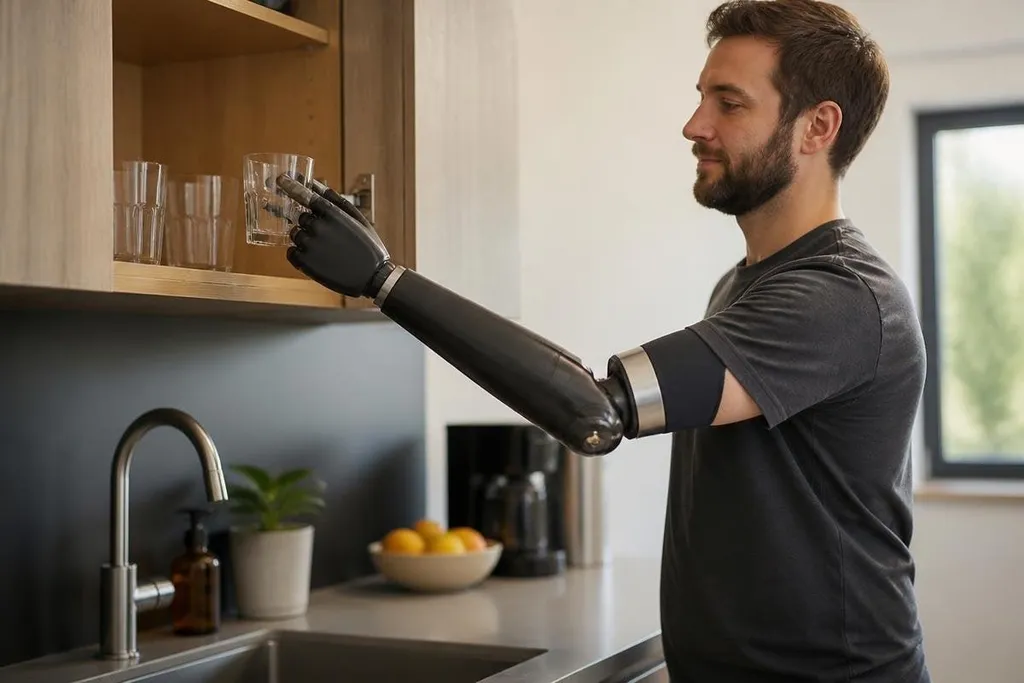
A bionic limb can react to muscle signals, move powered joints, and adjust its grip. The hard part is making those actions feel natural enough for daily use, from opening a door to carrying a cup.
- Muscle sensors can read signals left after an amputation
- Nerve links may add touch and pressure signals
- Fit, training, battery life, and repair still shape daily use
How bionic limbs read movement
Most powered prosthetic arms use electromyography, or EMG. Small sensors read the electrical activity in the user’s remaining muscles, then software maps those signals to actions such as opening a hand or bending an elbow.
That method works best when the user can repeat the same muscle signal. A socket that shifts on the residual limb can change the reading, so the same thought may produce a different movement. Sweat, clothing, and electrode position can also affect the signal.
Future systems will need better ways to read intent. Researchers are studying signals from peripheral nerves, which carry commands between the brain, spinal cord, and muscles. These signals may give a control system more separate inputs than surface EMG alone, though surgery and long-term care add medical risks.
Movement is only half the job
A hand that closes on command still leaves the user guessing how hard it is holding an object. That gap matters when the object is fragile, wet, hot, or easy to drop.
Force sensors can measure pressure at the fingers and wrist. A control system can then adjust the motor response, while electrical, vibration, or pressure signals may send information back to the user. This is called sensory feedback: the limb reports contact instead of leaving the user to watch every movement.
The signals need to be clear and useful. A buzzing alert that says “contact happened” may help less than a signal that tells the user where the pressure sits. Daily control will depend on training, signal quality, and how well the feedback fits the task.
The socket may decide the outcome
The socket is the part that connects a prosthesis to the body. It carries load, holds sensors in place, and affects comfort across the day.
A motor can work well on a test bench and still become hard to use if the socket causes pain or limits movement. That makes fitting a technical job, not a small detail. The shape of the residual limb changes over time, and the user’s needs may change too.
A design that works for a short walk may fail during a full work shift because of pressure, heat, or battery weight.
For someone choosing a bionic limb, a short lab walk says little about heat, pressure, or battery weight across a work shift. Bionic-limb reporting from Robot24.com can place those limits beside the control system, test setting, and measured result before the next section looks at what may change.
What may change next
Bionic limbs are likely to improve through better links between sensing, control software, and the body. A system may combine EMG, joint position, pressure, and motion data instead of relying on one signal.
That does not remove the need for practice. The user still has to learn how much muscle effort produces each action, and the software still has to handle missed or noisy signals. A limb that supports several actions may also need a reliable way to switch modes without accidental movement.
Cost and care will shape access as much as hardware. The price includes fitting, repairs, software updates, replacement parts, and training. If those services are hard to reach, a capable limb can spend more time waiting for care than helping its owner.
I’d judge a bionic limb by the tasks it supports for one person over a full day, not by the number of motors in the arm.
A practical buying checklist
Use these questions when comparing a powered prosthesis or a clinical trial:
- Ask which signals control each movement and how the system handles noise.
- Check how the socket is adjusted after weight or limb-shape changes.
- Test the grip on objects you use at home or work.
- Confirm how sensory feedback feels, where it comes from, and how long training takes.
- Get the battery runtime, charging method, repair plan, and replacement cost in writing.
- Ask which results come from daily use and which come from a short demonstration.
The next useful step is a longer test with ordinary tasks, repeated across days and handled by the same care team. Until those results are common, the best bionic limb will be the one that keeps working after the demonstration ends.